Category Archives: About Life in General

opinions about life today.

Facing Terrorism

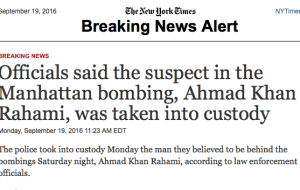
When I opened my computer today I saw the following headline:

screen-shot-2016-09-19-at-10-36-33-am“Oh, boy,” I said aloud. “The Muslim community must be going crazy.”

I hadn’t read the article yet. Didn’t know that Ahmad Khan Rahami had been radicalized. Didn’t know he was 28 and that his family lived in New Jersey. I just saw the name and guessed he was Muslim.

It reminded me of when I first read about Madoff. “That’s not a Jewish name, is it?” I asked my husband.

I was hoping that uber-scoundrel was not Jewish—not of my tribe. I knew that if one of us does something wrong, the rest of us gets painted by the same guilty brush. Even if we are completely innocent.

I was afraid of a backlash and that was before the recent resurgence of anti Semitism that is plaguing our country and our world.

I can only imagine what the law abiding Muslims across America are thinking right now. Gone was their hope that their names wouldn’t be linked with the identity of this terrorist. But the truth is that Ahmad Khan Rahami did this. Not a whole group.

When I opened the article I learned that Ahmad Khan Rahami shot the first officer who approached him in the stomach. He injured another. His intent was to injure and kill as many innocent citizens of New Jersey and New York as he could. He was going after civilians enjoying the last days of summer, just as all of us are in our own hometowns. The bombs were loaded to inflict huge damage to flesh and bone. No wonder he is called a terrorist. His actions are terrifying.

So what do we do? What is our course of action? Do we stay indoors and hide? Do we say that all Muslims are terrifying? Do we give into the terrorists’ acts?
I say no. Let’s stay on a steady course. Let’s not be afraid to live our lives. Let’s not forget the acts of bravery by the police and fire departments. Let’s use reason and rational judgment before we act. Let’s be intelligent about how we analyze what has happened and how we should react. Let’s be guided by wisdom and actual facts.


Writing Do’s and Don’ts Revisited

It’s time to continue Writing DO’s and DON’Ts. I am going to create some more of these quick lessons that are designed to help the writer right now.

Source: Writing Do’s and Don’ts Revisited

Leaving Yad Va Shem

IMG_8735
Though in the background the shadow people linger,
six million and more of them,
Here we stand, three generations:
the present moving toward the future.

Evil did not triumph.
The Third Reich turned to dust.
Their empire in ashes,
As were their victims.

Goodness prevailed
Though the cost was beyond measure.
Who can comprehend the savage brutality?

Who can deny that it happened?
What is in a hand?
What is in a name?
The fingerprint of humanity.
The identity of a soul.

THE MOST IMPORTANT TEST YOU’LL EVER TAKE:

Several friends and relatives in their sixties and seventies have said they no longer need Pap smears, mammograms, colonoscopies or PSA tests. “Oh, the doctor said I don’t need a mammog…

Source: THE MOST IMPORTANT TEST YOU’LL EVER TAKE:

THE MOST IMPORTANT TEST YOU’LL EVER TAKE:

Several friends and relatives in their sixties and seventies have said they no longer need Pap smears, mammograms, colonoscopies or PSA tests. “Oh, the doctor said I don’t need a mammogram at my age,” my cousin said. “Every older man has prostate cancer. It’s all slow growing so why have a PSA test,” a friend said. “At our age, we don’t need a physical every year,” another said.

WRONG! I’m here to give testimony that those opinions are wrong. I have four friends who were recently diagnosed with breast cancer and are now undergoing treatment. I have another who caught her uterine cancer in time because of a Pap smear. My own husband was just diagnosed last week with prostate cancer because of an elevated PSA test. And it’s not slow growing.

“Cases of aggressive prostate cancer appear to be on the rise,” NBC reported yesterday, citing a Northwestern University study.

“Prostate cancer is 100 percent treatable if detected early, but some men are more likely to develop aggressive disease that will recur, progress and metastasize,” said Dr. Jonathan Simons, president and CEO of the Prostate Cancer Foundation.

“Not all men with prostate cancer need immediate surgery or radiation. But every case needs precision prostate cancer care,” Simons added.

PLEASE DO NOT BE TALKED OUT OF THESE IMPORTANT SCREENING TESTS.

I’m on my way to have a mammogram now.

A Fine Line

My essay, A Fine Line, is published at http://rkvryquarterly.com/


“A Fine Line” by Cyndy Muscatel

If only I hadn’t decided to go out on deck that night.

Anchored in the middle of the Galapagos chain of islands, our boat floated on the Equatorial Line with the ease of a high-wire aerialist. The lure of the night sky called, and I slipped out of our cabin to stand by the rail. How could I not go out and see the Southern Cross high above me to my right—the Big Dipper and the North Star to my left? I was smack-dab on the middle of the earth.

Who could have guessed that one of the mosquitoes using me as target practice that night was illiterate? We were in a “No Malaria Zone,” dammit. I’d checked twice with the CDC before we left for South America. My luck—Ms. Quito Mosquito, an Anopheles by genus name, was an empty-headed beauty queen who didn’t care about the pronouncements of the World Health Organization. She was an indiscriminate vampire who’d gotten mixed up with some malaria folk. Filled with their plasmodium, she paid it forward, thrusting the microscopic parasites into my bloodstream. I really don’t blame her. She was a fact of Global Warming. I became one of its victims.

I almost died. That sounds so melodramatic I feel embarrassed to write it, but it’s true.

“Her fever is still spiking at 105. Now her kidneys are shutting down,” the doctor said to my husband. They stood on either side of my hospital bed talking as if I weren’t there. I was—I just didn’t have the energy to open my eyes. I was so weak by that point my body couldn’t even gain purchase on the bed. The nurse’s aide would pull me to the top, but I’d slip to the bottom within an hour.

“Well, what do we do?” my husband asked.

“I don’t know,” the doctor said. “But I’m thinking she has only twenty-four hours left to live.”

“What are you talking about? For Christ’s sake, she’s strong and healthy. She just did the Inca Trail two weeks ago. You better figure out something.” The aggressiveness in my husband’s tone was comforting. Although he knew nothing about taking care of someone who was ill, his Type A personality got things done.

They moved out of the room, but I could hear the murmur of their voices from the corridor. I tried calling out, “What are you talking about?” but my feeble attempt went unheard. What was the doctor saying out of earshot? I wondered. Could it be any worse than what he’d just said?

We’d been having problems with the doctor from the beginning of my illness five days before. My first symptom had been an aching in my legs, which spread to all my joints. That morning I was supposed to pick out granite for our house remodel. I told my husband I felt achy and exhausted—we both attributed it to our arduous trip in Peru and Ecuador. I drove myself to the warehouse, but by the time I got there I felt I couldn’t keep my head up. I managed to choose the granite and through force of will to make it home and to my bed. From then on, the world became murky.

I do remember calling my daughter in Los Angeles and telling her how sick I felt. She started keeping close tabs on my symptoms and began plugging them into the computer. On the second day, she called the doctor to tell him she’d been checking online and she thought I had malaria.

He freaked out. “Don’t you ever call me again with this kind of crap,” he told her. “I am the doctor—I make the diagnosis.”

Even though we’d just returned from a third-world country, he refused to consider the possibility that I had an infectious disease picked up on my travels. He was obdurate until he got scared that I would die. In desperation, he relented. Fortunately for me, it wasn’t too late, and fortunately the infectious disease specialist was from Pakistan. He’d seen malaria many times and put me on the malaria antibiotic doxycycline. Within eight hours I was able to sit up and dangle my feet over the side of the bed.

The next morning, the aide who had wiped my face and arms with such care for four days while I shook with fever was able to guide me into the bathroom. It was the sixth day since I had fallen ill.

“Oh my God. My face is so yellow,” I said when I looked into the mirror.

“Not as yellow as it has been. It’s much better,” the aide said.

I looked again and thought the color appalling. Then I saw how thin I was—beyond gaunt. I hadn’t eaten anything since the aching began. When they weighed me, I had lost fourteen pounds. I also lost my appetite. It took days until I learned to eat again. When they brought me a tray of food, a slab of something covered in gravy, I was so nauseous that I almost passed out. Finally I was able to nibble on soda crackers and sip some ginger ale.

For much of the acute stage of my illness, I was in Hallucination Land. Once I was hospitalized, I saw myself in the Chicago train station every afternoon at 4:00 p.m., waiting in line to buy a ticket to Syracuse. It was always my turn next. On the Sunday the neurologist administered the spinal tap, I hallucinated up a soothing mid-century décor for the procedure. The room was low-lit with futons in aqua and coral. That night I was forbidden to move for eight hours, but the bone-aching pain made me toss and turn. A handy-dandy hallucination had me imagining I was cradled in the arms of four strong women, although in reality it was my husband holding me tight.

I had other mental experiences that were not exactly of the “real world.” I saw a faraway light with a door sliding shut on it. I knew if I didn’t keep the door open, it would be the end for me. One afternoon I was overwhelmed with the effort. “I’m too tired,” I said in my head. “I’m going to let it go.”

But my father came to stop me. I think he was dressed in one of his satin smoking jackets. He’d been dead for two years. “Daughter, we don’t give up in this family,” he said.

“Okay, Dad. I’ll keep trying then.” Knowing he was close by, the task no longer seemed as difficult. Dad was as real to me as the nurse who came in to take my temperature. Maybe more real.

Then there were the children only I could see reflected in the blank television monitor. Dressed in white, they stood around my bed, which was now in a lush garden. I leaned forward and a cherubic baby popped up from behind my pillow.

“Maybe they were angels sent to guide you to heaven,” my friend Else said when I told her later.

I shook my head. “No, that wasn’t it. They were taking care of me. I am safe with them by my side.” It was as clear a statement as my slurred speech allowed.

The slurred speech thing got me into trouble. In my head, I heard myself talking normally. I had no idea that the thirteen words came out as four aloud, and garbled at that. My husband thought I’d had a stroke. My son and daughter, both hundreds of miles away, were frantic. Friends who came to visit me in the hospital told me later they cried at the elevator when they left. They all thought they had lost me. I, of course, was in oblivion.

Going back to the general topic of malaria for a moment, the parasite burrows into the liver. I know this because malaria has become a hot topic, and it was the cover story in National Geographic. That’s why I was jaundiced. But I can tell you from experience that those little buggers hit each body organ hard. Talk about the domino effect. As they circulated, the newest system they entered went wonky. I had MRIs, CAT scans, PET scans, a colonoscopy…you name it. But I felt it was my head, inside and out, which took the brunt of the barrage. I lost everything from memory to handfuls of hair. Parts of my memory, short and long term, were wiped clean. Even today it’s hard to figure out if I’m having a senior or a malaria moment. One strange aside is that my ability with numbers increased. I am better at math and can memorize numbers that I never could before. As for my hair, it seems to have highlighted memory. Lots of it still falls out every year in May—in memory, I guess, of my case of malaria.

Joking aside, the language issue was tough on me. If I am vain about anything, it is my facility with language. Words have always come trippingly to my tongue, but for months I had aphasia—I might have said fork when I meant foot. Some words were simply gone. Like Ottawa. I was reading Middlesex and I had no idea if Ottawa was a place, a car, or some kind of food. Not knowing made me feel as if I were surreal. I couldn’t write for a year—couldn’t put the proper mix of words together. It was so frustrating, I abandoned the effort. This from a person who thought the essential items to bring to the hospital besides clean underwear and lipstick were a pen and notebook. I wrote every day while I was there. I kept the notebook—none of the handwriting looks like mine.

When I went home from the hospital, I was still very sick. My recovery was no faster than the pace of the tortoises we’d watched in the Galapagos. I had a fever and a cough for months. I woke up sweating and parched every night. I could not get my energy back. I also used to have the shakes all day long. Those tapered off, but even now, six years later, if I get overtired, I’ll wake up in the middle of the night, shaking. And I could not get my energy back. I didn’t have that buffer between feeling tired and complete depletion. It’s only in the last year that I don’t have to nap each day.

As I reread what I have written, I am struck by how close I was to dying. I wonder when it is finally my time if Dad will be there again, this time to welcome me in. In? In to where? Heaven? But I don’t believe in Heaven, do I? Or life after death, for that matter. I believe that when we die our individual spark leaves our earthly bodies and soars back into the teeming, churning mass of the collective energetic field of the universe. But what if I am wrong? What if on that May afternoon when I looked into the television that wasn’t turned on and I saw a lush garden—what if I were seeing heaven?

When you almost die, it does change you forever. As my body started to shut down, I didn’t think about the novels I never got published or whether I’d been a good mother and grandmother. I accepted I was dying and I had few regrets. Except I remember distinctly asking myself, But what about the fun I was going to have? Where did the time for enjoyment go? It will be a shame to miss out on that.

I have never forgotten that. I have a worker-bee mentality, but I am getting better at plain enjoying life. I also lost my ambition. I had a novel half finished and completely outlined. I think it was good—I liked the characters and the plot was strong. At first I wasn’t strong enough to go back and finish it. By the time I got my concentration and language back, I’d lost interest. I eventually returned to magazine writing, doing feature interviews with entertainers, authors, politicians, and professional athletes. But when my editor quit, I left with her. I wasn’t willing to put up with the unsteady ego of a new broom. And I don’t miss it. I love the freedom to be able to travel whenever we want. I love the freedom to be able to write an essay, a blog, a poem, or a short story without feeling I have to have it published to prove myself. I want to experience life not to only write about it. I no longer think I have an endless stream of days, so each one is more precious than before.

If I could, would I change that moment and not go out on the deck? Part of me says yes—I have certain health problems that I know were brought on by the trauma of the disease and the fever, and I’d certainly like my full head of hair back! But the experience is part of the fabric of my life. I have learned so much from it. Besides, I got to balance for a while on the greatest equatorial line. I got a peek into eternity.

 

Turning Seventy is Sublime


10639566_939149096181665_1296904217772286777_n


I am in the middle of writing an essay about how wonderful it is to be 70. I started it in January, but got caught up in other things and in writing a memoir piece. So now I’m almost half way to being 71. With luck and time, I will finish the essay before that birthday.

Meanwhile, I’m going to share some thoughts. On my 70th, I was determined to not look or feel my age. It was a lot of work! Now I’m purposefully slowing down—as a matter of fact, I took myself out of the race. I’m not so touchy about people holding a door open for me or asking to help me with my grocery bags. I don’t have to be in charge. I don’t have to be the responsible one. I don’t have to try proving that I’m as strong and capable as I once was. I can surrender to the aging. I can admit that I get tired. I can admit that I can’t lift my suitcase. I can admit that a swimsuit is not my best look, but I’ll wear one anyway.

One of the great benefits of aging is that I like being who I am. I say to myself when I’m doing something, “You know, that’s who you are. You’ve always been that way.” And I feel good rather than thinking I should change to conform to somebody else’s ideas. It’s true, for instance, that I rather write than play golf.


1463507_945001662201796_7026500439035859584_n

I still think of myself as young. For instance, if I’m on a bus or train, I’ll stand up to give my seat to an older person. Only… what’s happening is that sometimes there is no older person. The first time this occurred was last summer when I went to DC to look after my grandson who was interning there. To begin with, that was a joke. Garrett, in reality, looked after me. He set me up with a Metro pass and with Uber. He made sure I was fine when he went to work. He’d call to check on me. He made the dinner reservations and showed me where the washer/dryer was in the building. The day we took the Metro to Capitol Hill, he made sure I got on the train without any trouble. I was standing next to him when a man asked me if I’d like his seat. I smiled and looked around for an older person to take advantage of his offer. Then I realized I was the oldest by at least twenty years. That was a “Yikes” moment!

I’m not denying that aging comes with a lot of loss. We have lost so many dear friends and family to cancer, heart attacks and strokes. Or they are suffering with the effects of their disease. There is a sadness now that really has no time to go away. Then there is the loss of taut skin, height and strong muscles, eyesight and hearing—but let’s not go there right now.

21592_1088527101265037_315147649320619505_n

I want to age gracefully, but I want to have fun too. Cindy Joseph’s make up tips for older woman have been widely distributed on Facebook. Here’s some of her advice around the eyes: “Women older than 50 tend to lose definition in their eyebrows. Just go with that. Don’t recreate the brows you had in your 20s.”

Really? I liked my eyebrows in my twenties, and if I don’t use eyebrow pencil now, I have no definition at all. I also tint whatever eyebrow hairs I have left. True, I don’t want to get to the stage where I’m drawing them on and entirely missing the eyebrow line. That is not attractive. But I figured out the solution to that: getting a stronger magnifying mirror for now and a trusted helper in my nineties.

Joseph also says: “Do not wear any eye shadow at all. …A little bit of mascara is OK.” Sorry, Cindy, but I plan to be wearing eye shadow in my coffin when I’m a 110. I love eye shadow. I’ve loved it since I was 13 and my mother wouldn’t let me wear it. So I’m not giving it up now or ever. I had a friend who got false eyelashes when she was 84. She loved them and they were cute on her! So there!


America, the Beautiful

America, the beautiful. Or is it America, the beautiful? I think it’s probably both. Certainly this country is not perfect. Certainly, I would live no where else. And I’m eternally grateful to my grandparents who had the courage to flee Russia and Lithuania. As they sailed into New York harbor, they felt the protecting shelter of the Statue of Liberty and the benediction of Emma Lazarus’ words: “Give me your tired, your poor, / Your huddled masses yearning to breathe free”.

IMG_8412

Their way was not easy when they hit these shores. Instead of the streets of gold they’d heard about, they found only poverty, hardship and prejudice. But they weren’t afraid they’d be killed outright as they had in Europe. With hard work and perseverance, they could build a successful life. And they did.

IMG_6518

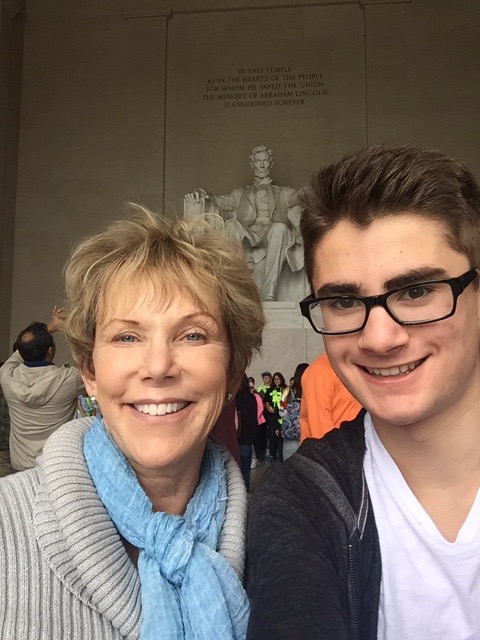
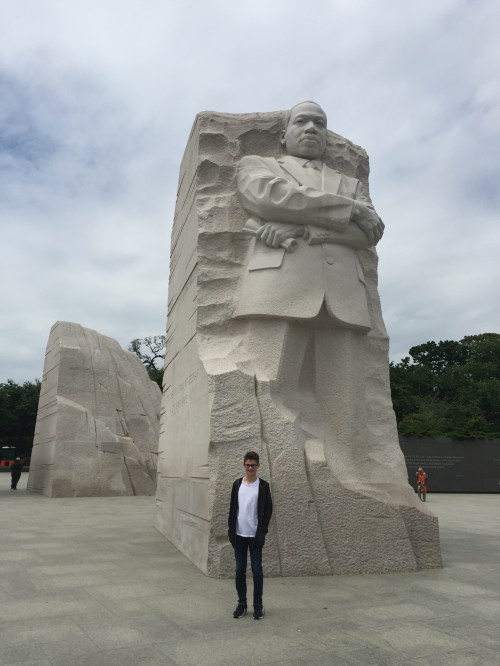
Fast forward a hundred years and their granddaughter has been lucky enough to go to Washington D.C. three times in the last ten months. Who’d ah thought? I’ve toured the Capitol Building twice and the White House once. I’ve toured the monuments all three times. I’m now a junkie!

IMG_8457

The city is built on a grand scale that we don’t see much of in our united states. Statues and magnificent buildings are interspersed with green parkways. It’s beautiful, truly.

IMG_8443


This last trip I was at an ADL convention. The Anti-Defamation League was originally founded in 1915 to protect Jewish people from Antisemitism. It has grown and broadened its goal to protect all human and civil rights. I feel safer at night to know the ADL exists. I was impressed by the dedication of the young people attending, and inspired to action, myself.

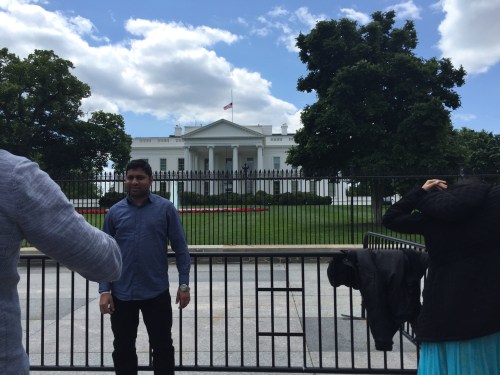
Our hotel was only a ten minute stroll from the White House and I walked to it a couple of times. Tourists from around the world flock there. It’s impressive both because of its architecture and its significance.  My four-year-old granddaughter walked there with her babysitter. My daughter and grandson walked there to see it at night.

We were home only two days when I heard about the shooting at a White House check point. It sent shivers down my spine. What if one of my family had been there then?


IMG_8388

“Did you hear about the shooting at the White House?” I said as I walked into the dentist’s office.

“I hope they shot Obama,” a pleasant looking woman said.

I was taken aback. “Too unkind,” I said. “He’s our President.” Where’s the respect? I thought. There should be some respect for our President, if nothing else. Just plain old human decency.

The woman gave me a dirty look and turned her back on me. I sat down across the waiting room, not looking at her either.

Where has all the civility gone? I wondered. Long time passing.

Will it take another 911 to get out the “United We Stand” posters, and to bring back the realization that we’re all Americans, all part of the same family? Disagree, fine. Disparage, okay. But to wish someone’s injury or death? That’s too ugly of an American for me.


Older, But Wiser?

Lately I’ve been meeting people who have a preconceived notion of me. They’ve buttonholed me into several categories: old, entitled white person, golfer, living a life of leisure, problemless, one …

Source: Older, But Wiser?

Older, But Wiser?

Lately I’ve been meeting people who have a preconceived notion of me. They’ve buttonholed me into several categories: old, entitled white person, golfer, living a life of leisure, problemless, one foot in the grave… Maybe the last is unfair, but sometimes I see the look in the eye.

We stayed in Hawaii this winter for four months. We always said that when we got older, we’d live in Hawaii because we love it so much. One day, we looked in the mirror and said in unison, “That time has come. It’s now or never.”

rainbow

Our condo is by a hotel on a golf course so my gregarious husband meets a lot of people at the driving range.

“You’re playing golf with us Monday morning,” a new acquaintance of his says one evening as we sit watching the sun set.

I shake my head. “I don’t really play golf.”

He looks amazed. “You don’t? What else do people do here? Well, come with us anyway. My back is bad so I’m only chipping and putting.”

“Sorry, but I’m busy Monday morning. I teach a class.”

He looks at me, trying to assess what I could teach at my advanced age.

I don’t offer any more information. I’m sitting at the beach trying to absorb the fact that someone I’d been talking to yesterday had died five hours later in a car crash. A guy who was only two years older than my son. A guy who was a sweetheart.“What kind of class?” the man asks.

“A writing class. A memoir writing class,” I say.

“Really. I should talk to you. I’ve written a book,” he says.

Oh here we go, I think. Another stranger who wants free help.

“That’s great,” I say with no enthusiasm.

“Yeah, it’s sold over a million copies. It was at the top of the bestseller list.”

Now I’m confused. He obviously needs no guidance from me.

He begins to tell me about his phenomenal success with his self help book.

“Very nice,” I say, wishing I had the guts to tell him he was blocking my view of the sun setting behind him.

“That’s nice you have something to do to occupy your time,” his young wife, a fantastic golfer, says.

“Really?” I want to say. “Occupy my time, as in giving me something to do while I’m in God’s waiting room? No, I’m very much alive and busy living each day.”

But then I think I may be a little defensive, and I stay quiet.

Two days later, I’m in a store and the saleswoman ringing me up says, “So you live in California part of the year and Hawaii part of the year? I’d sure like your life style.”

I look at her and try to imagine what she sees when she looks at me. I settle on: privileged white person living a life of leisure with not a problem in the world. (Again I was probably being defensive and over sensitive, which I need to get over…some day. )

She’s not the first thirty-something-year-old to say this to me so I have a ready response: “You live another forty years, work hard every day and save your money. Then you, too, can have this life style.

I say it kindly and with a little laugh, but it’s the truth for me.

img_8039