England Is My Cup of Tea


I found myself riveted by the events unfolding in London during the Diamond Jubilee weekend. I couldn’t get enough of watching the Royals, young and old. As my friend Lee said, “No one does pomp and circumstance better than the British.”

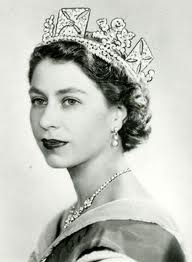
I am a long time Anglophile. I’ve always thought it dated back to being an English Lit major in college, but now I think it started with Queen Elizabeth’s coronation. As many people during the televised coverage commented, this was also when my family got a television. I remember standing right in front of the tiny set so I could see all the pageantry. I fell in love with the Queen right then and there.

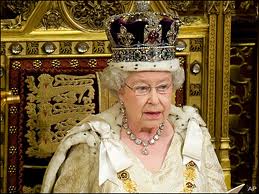
Sixty years later, little had changed. Oh, the plasma screen was much larger and flatter, but there I was standing right in front of the television to not to miss a detail. I must admit that the new technology made me feel at times as if I were on the royal barge right next to the Family. I kept an eagle eye on the stiff upper lips that trembled, despite their best efforts, in the cold. I wondered if the Queen’s pashmina was at all warm enough for her? And Prince Philip, standing so erect in the pouring rain? Could this be good for a 91 year old? Was this bravery going to create a situation like President William Harrison’s? He died of pneumonia one month after his inauguration in the snow.

And sure enough, Prince Philip landed in the hospital. I just went on line to see how he’s doing and watched a video of a beaming Queen Elizabeth after a visit with her husband. A palace insider was quoted as saying, “Prince Philip is as tough as old boots and the last thing he wants is to be stuck in hospital on his birthday weekend.” So hopefully he is on the mend.

In another way, it was interesting to watch the celebration unfold. I felt as if a P.R. firm of the highest order carefully orchestrated each event. You could see that the rehabilitation of Charles and Camilla was complete. The scandalous couple of the nineties was front and just to the left of center the entire weekend. Camilla even sat next to the Queen in the open landau and they seemed quite chummy. Not a mention of a tampon anywhere.

Who the Queen is supposed to be has changed over the years. Her Royal Majesty has always had such a royal majesty about her that she has seemed set apart. Her proper demeanor and attitude of noblesse oblige solidified this persona. It seemed the concert evening was dedicated to demonstrating that the royals, just like the common folk, could get down and boogey. (Even Princess Anne who looked like she’d just stepped out of a 16th century painting, could nod her head in rhythm to the music of Paul McCartney.)

The last time we were in London, my husband and I took the tube from Heathrow into the city. It’s almost an hour trip. I think we were the only people of non-color aboard. England is an island whose residents reflect the population of the Commonwealth nations. Watching the thousands upon thousands lined up to see the Queen, I couldn’t help notice that most of the faces the cameras scanned were white. What the significance of that was, I’m not sure. Whether it bodes ill for the monarchy, I don’t know.
Times are a changing. Succession will go to the first born man or woman from this time forth!

About thirty years ago, Queen Elizabeth visited Seattle, where we lived. I took my children out of school early so we could get downtown to see her. We were lucky and got up fairly close. I remember being struck by her daintiness and the lovely smile she bestowed on everyone. It furthered my respect and affection for her. Even these many years later, through the scandals, unrest and troubles, she has maintained an unwavering poise.

I want to add my hip, hip hooray. Long live the Queen!

 

The Loss of a Parent is so Final

My mother-in-law’s funeral was the day after Mother’s Day in Seattle. We had told our Chicago kids not to make the trip out—the airlines just gouge you now on last minute reservations—but our son and daughter-in-law insisted they come so we could all be together with them and our daughter’s family. I am so thankful they did.

My mother-in-law was ninety and her quality of life was so diminished by dementia and heart failure that we shouldn’t have been shocked that she died. But we were stunned by the phone call at 10:00 am on that Friday morning. Maybe it was because I had talked to the social worker at the Home the day before, and she’d said that Esther was pretty much the same as she’d been the month before when we’d visited.

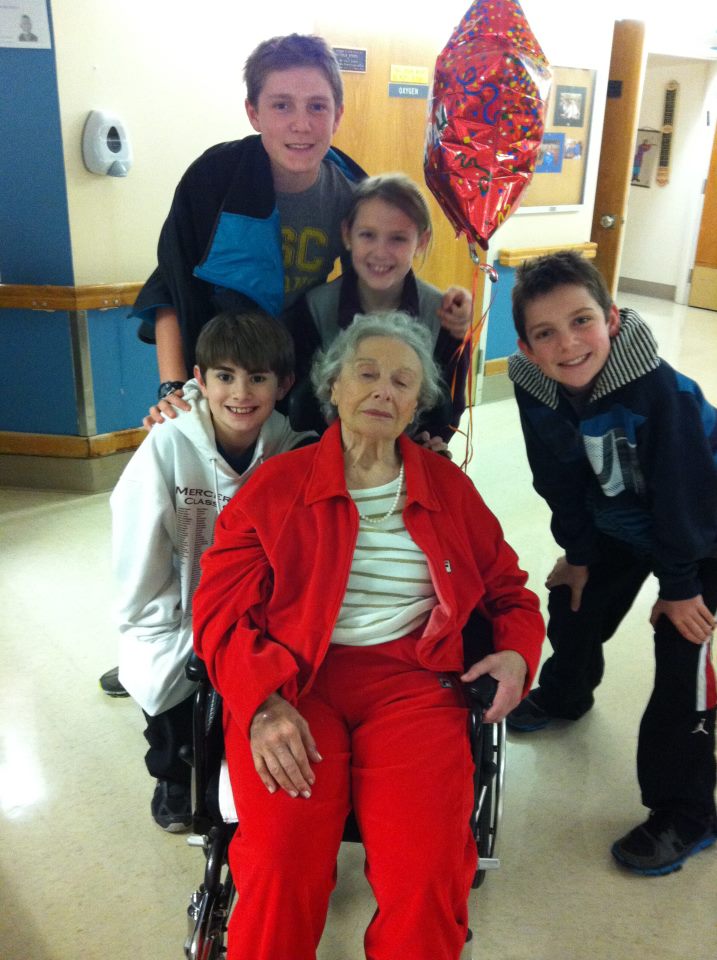
90th Birthday Party in November.

“Just fading a little more each week?” I asked. “Going gently into that good night?”

“I couldn’t say it like that, but yes. And she’s comfortable, not in any pain, and still eating.”

My husband and I talked about it a dinner, wondering how much longer she would be able to last. Would she make it to her 91st birthday? That she was still eating seemed an affirmation of living, but what kind of life was it anyway? It took two peopIe with a hoist to get her out of bed. She rarely opened her eyes. We didn’t want her to suffer and we knew she wasn’t going to get better.

Yet, we both felt anguish when she died. Death is so final. There it is and nothing will change it. Anything you wished you’d said or done—so what? Not happening. Ever. The line that separates the living from the dead cannot be crossed.

My husband had had major surgery three weeks before and wasn’t really cleared to fly, but we started packing. We were definitely spacey and unfocused. Just after noon, we got a call that the orchid I’d ordered for Mother’s Day had arrived at the Home. That was a little weird for everybody.

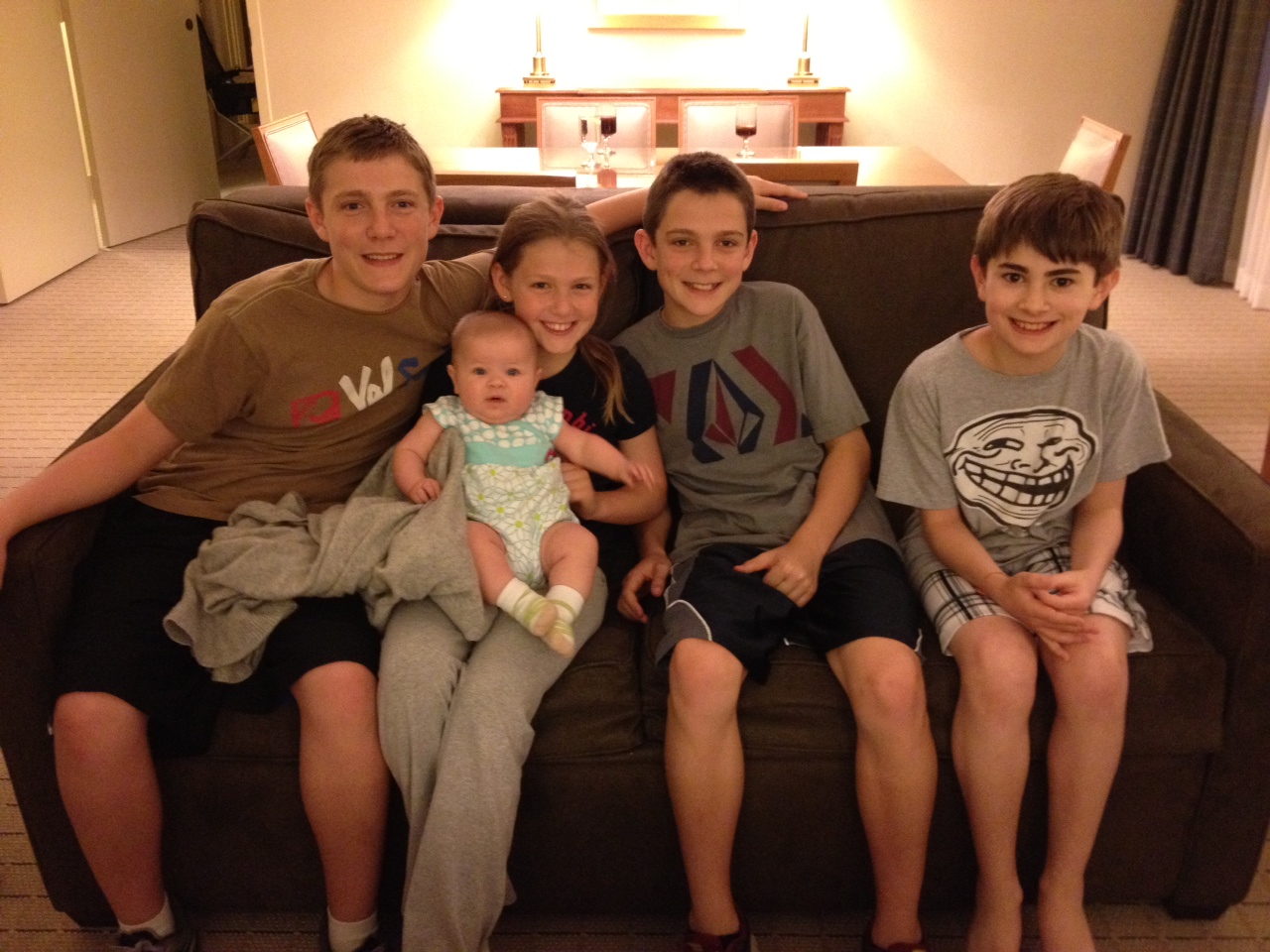
The flight to Seattle was difficult even sleepwalking through it. We barely talked to each other, and both of us went into deep sleeps at times. Then our daughter picked us up at the airport with her 11-year-old son and 4-month-old daughter. The endorphins stared flaring as soon as we saw them. Everything calmed down a bit. When the Chicago family arrived in the evening, all of a sudden it became a celebration of life. Sadness and loss were set aside as the new baby met her cousins! The beaming smiles on all the faces as they passed baby Joeli from one to the other, helped heal my shaky heart.

Although this is off topic, I have to add a conversation I heard between 9-year-old Quinn and her cousin, Eli, the new big brother.

“So, the last time I saw you, you couldn’t wait to have a sibling. How do you like it now?” Quinn asked, sounding a bit like Dr. Phil.

“It’s okay,” Eli said. His enthusiasm level wasn’t high.

“It’s not what you thought?” Quinn asked.

I couldn’t resist. “He thought he was going to get you, Quinn. Someone to play with.”

Eli laughed a little, but agreed. “Yeah, Joeli doesn’t do anything.”

Quinn nodded sagely. “Just you wait. When she starts crawling, it will be better. She’ll be more fun.”

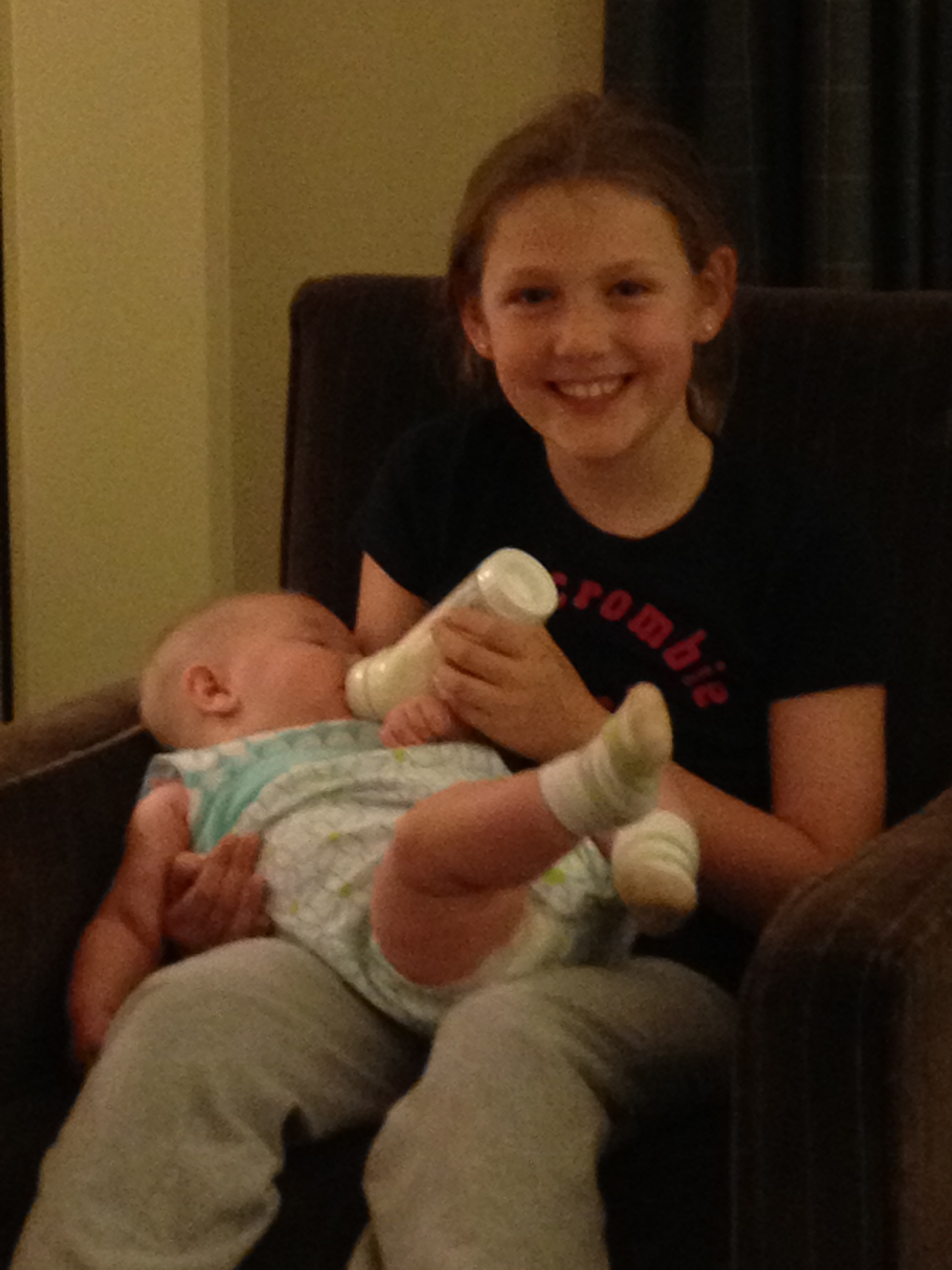
Quinn, wise beyond her years, feeding her little cousin.

I looked at her in amazement. How does she know that? I wondered. Just listening to that conversation was priceless. I have to thank my mother-in-law for bringing me all these treasures.

Our return to Palm Springs was easier, but looking back, I realize we settled into a gloom that bordered on depression. On the one hand, we were lucky to have the luxury of quiet days and evenings. So often in the world today, you’re expected to “just get on with it!” No more weeks of coming to terms with the seismic change death brings in your life. On the other hand, we suffered from a malaise that almost paralyzed us. Mid-week, I received a note from a friend that helped so much. Joan wrote, “The loss of a parent is so final, bringing up past loss and grief, as well as the acknowledgment of the fragility of life.”

It was an “ah-hah’ moment. I realized we had been grieving not only for Esther, but for all our parents. This last Sunday was the tenth anniversary of my dad’s death, and I cried more that day than when he died. We lit a candle and said a prayer for all our parents—very healing. Then we did go out—to a 100th birthday party. Talk about an affirmation of life!

This week is much better. We are more normal—whatever that is. We are moving forward. I did clean out my office, which I’ve been going to do for four years. I also sorted through my father’s stuff I’ve kept on a shelf for ten years. The garbage and recycle cans are full. We both are aware of the sense of an ending in our lives. We’re leaving the past behind—the goal is to appreciate each day that much more.

Writing DOs and DON’Ts

Writing DOs and DON’Ts.

Cancer is a word, not a sentence.

I am driving in heavy traffic to Cedars Sinai Medical Center. It takes all my concentration to navigate the 405. This freeway is always clogged with crazy L.A. drivers. A lot of them think their destination is more important than anyone else’s. Talk about entitlement in action!

My appointment is at 9:45 and it’s already 9:10. I feel like I’m in a capsule creeping along a slow moving conveyer belt. My mouth is so dry I have to gulp down some water. I re-grip the steering wheel and notice that my palms are damp. My palms are never sweaty! I order myself to take a deep breath. RELAX, I say inside my head. BREATHE.

I know it’s not just the traffic that’s making me so anxious. I’ve been nervous for two days, but in an under-the-radar sort of way. I was edgy and impatient even if I didn’t show it to our grandkids who were visiting from Chicago. This personality transplant is nothing new. Well, not for five years anyway. It happens every time I have to go to Cedars.

I’ve tried to “get over it”—even went to a therapist to talk about it. It’s been five years since I was diagnosed with uterine cancer. Logically I know I’m fine. I was lucky to have caught it early. Lucky to have a daughter I could confide my symptoms to—lucky that she listened and insisted I see a doctor. I remember thinking she was over reacting, but I made an appointment with my gynecologist, who did a biopsy that same day. The results showed early stage cancer. I share this with you in case you have the same symptoms. I consider myself intelligent and savvy, but I didn’t have the knowledge that this “period” was no laughing matter.

“You have no idea of how many women come to me too late,” my oncologist told me. “They’re too busy, or they think maybe they’re really not done with menopause or that the bleeding will stop.” She shook her head. “With you, surgery will get the job done. You won’t even need chemo. It could be this way with everyone if they just came in before the cancer spread.” She seemed so sad. I remember that clearly even though I was still shell-shocked by my diagnosis.

The surgery went really well. At my six-week check up, they explained there is no 100% certainty you are cured and will continue to be cancer free. It ain’t over ‘til it’s over is more the case. “While I feel certain we got all the cancer, that is not proof. So we’ll want to see you every two to three months for the first two years,” the oncologist explained. I liked the way she looked me in the eye. “Then every four months.”

Five years later, I’ve graduated to every six months. That is a good thing—Now I only put myself through this torture twice a year. I leave my house, a functioning person concerned about the economy and the coming elections, and I evolve into the woman who is afraid to trust her own body—a woman who’d had cancer.

Today, the bumper-to-bumper traffic ratchets up my anxiety so I get off the freeway at Sunset Boulevard. It’s a pretty street and I can relax for a moment as I wend my way towards Beverly Hills. But somehow, even though I have been driving this route for five years, I overshoot the Cancer Center once again. I’m lost and have to figure out how to get back to Beverly Boulevard. By the time I get to the parking lot, I have five minutes to check in for my appointment.

I go into the lobby and get in the elevator, my mood descending with it. It’s as if a time machine hurtles me back the five years. The fear and disbelief I felt back then reappear like spectral holographs, hemming me in. I start repeating the mantra my cousin told me, “Cancer is a word not a sentence,” but then I think, what does she know? She’s never had it.

I check in at reception, get my wristband and go to the waiting room. It’s filled with men, women and children who come and go as if they’re playing musical chairs. The teenager who’d come down in the elevator with me starts to pass out. His mother calls out for help and a white-coated man rushes to grab the kid before he hits the floor. This mustn’t be an unusual occurrence because no one pays much attention to it. Or maybe it’s because I’m a writer that I watch it all—the mother sagging against the wall for support, then straightening up to shuffle along side the wheel chair, her hand hovering over the boy’s shoulder.

I finally get called. I go into the examination room and the transformation is complete. I’m a cancer zombie, again. This sterile, cold room with its diagrams and cancered models of female parts is where I was given the diagnosis. That moment starts instant-replaying in my head.

It’s better when the young resident comes in. She asks me questions with a caring and attentive air. The doctor breezes in, trying to look like she doesn’t have a dozen patients waiting for her. As she examines me, she asks what book I am reading. We always talk books. When she finishes the exam, I sit up. She is pleased, finding everything healthy. “You’ll get the PAP smear results in a week,” she tells me. “I’m sure the results will be negative.”

Once I’m dressed, I walk to the elevator, keeping my eyes on the linoleum floor, not looking to the left or the right. It’s become a ritual of safe passage. I come out of the building and stand on the curb, waiting for my car. The warmth of the sun soothes me. I hadn’t realized how cold I was. My hands are like ice.

For some reason, tears fill my eyes. I really can’t tell you why.

A.D.D. plus E.S.P. = A Mind Field

I used to be a multi-tasker extraordinaire. I remember once when my kids were in elementary school, I baked a blackberry pie while talking on the phone. Those were the days when you had a wall phone with a receiver you could jam into the crook of your neck. (That’s what we called hands-free back then.) I remember my kids kept coming into the kitchen so I could help then with various things. Meanwhile I was washing the berries I had just picked, sifting flour, and rolling out pie crust. All of it seemed effortless. Even the pie turned out to be delicious. I was proud I could handle everything with ease.

I look back and realize that I wasn’t totally present for anything that day—the phone conversation, the kids, the pie. I was getting a lot done, but I wasn’t really experiencing any of it. Now, I want to be more present—to enjoy each moment more fully.

These days I try not to multi-task. I have to do this consciously as I am a Random-Abstract thinker and doer. This term comes from a teaching theory that says people have different brain styles. Some people are very concrete in their analysis, and specific in creating solutions. Some people are more random, pulling from different parts of their brain. Their solutions appear more abstract.

Sometimes Random-Abstract works, especially for creative ventures. It’s a boon to my writing self. Sometimes Random-Abstract is not so good. I can’t tell you how many times I have left eggs boiling on the stove and forgotten them. I’ll think of the perfect phrase for a short story or poem, and head to the computer. I have good intentions of returning to the kitchen, but once sidetracked, I am basically a goner.

One time we were seeing Robert Morse in “Tru” at the McCallum when I suddenly remembered I had been going to make egg salad for lunch. I’d become distracted, leaving the eggs simmering. Two hours later, I looked at my watch: 3:16.

Oh, my god, I thought, the eggs! The water has completely boiled out of the pan! The eggs have exploded! I could visualize the house filled with smoke, the fireman, his ax poised, ready to knock down our front door.

“We have to go home right now,” I told my husband.

“It’s only the beginning of the second act,” he said.

“But, I left eggs on the stove!”

He patted my hand. “No sweat. It’ll be fine.”

That’s the last time he ever said that. We got home and found the house filled with smoke and black soot everywhere. Fortunately our smoke alarm had alerted the fire department. It was all just as I’d imagined, except the front door was intact. That was because our neighbor had stopped the fireman with the ax. “I told him I had the key,” Alex said.

The really eerie thing about that experience was that the Fire Department’s report showed they had arrived exactly at 3:16—just when I remembered the eggs.  My brain certainly functions in abstract ways. I am most likely ADD, but perhaps, I’m ESP wired, as well.

I’d like to report to you that I’m better about leaving things cooking on the stove or water running in a sink or turning off appliances, but why add lying to my sins. A side effect of the problem is that I’ve developed a morbid fear of burning down my house.

I told that to a therapist once. “Sometimes when I’m already in my car I have to go back into the house and check. Do you think that’s OCD?” I asked.

She did and wanted to put me on medication for it. Then I explained my history with the fire department.

Instead of meds, I’ve worked on developing strategies to prevent disaster. I now have a hard and fast rule that I cannot leave the kitchen if I am hard boiling eggs. If I am soaking stuff in the sink, I can’t leave until I have turned off the water. And I buy appliances, which turn themselves off.

So far, so good.

An Ol’ Dog Learns a New Trick

The Kitchen Sink

I am a personal growth story. Unlike Peter Pan and his crowd, I do want to grow up. I’m constantly striving for a calm center, something I wasn’t born with either physically or mentally. Nature and nurture didn’t endow me with the traits to achieve an inner peace—probably the opposite. But you can teach an old dog new tricks. I am learning.

Last Saturday was a perfect example. I was cleaning my kitchen and decided to get rid of some uncooked pasta that had been sitting opened and unused for over a month. I looked at the package and at the garbage pail. (I’m very proud of how little garbage we have. I am an excellent recycler. Now, there goes the hubris! Pride goes before a fall.) I could have thrown the package away, but I decided to put the noodles down the disposal. (Quite off the subject, I do have this conflict quite often. Which is better for the environment—less objects in the landfill or less use of water and electricity?)

As I fed the thin pieces of pasta into the disposal I did wonder if I could be creating glue. I have to say in 40 years, I’ve never done anything like this. My parents were of the Depression Era, and their mentality was passed to me. Never throw away anything you can use. But this time, I was going to do it. We used to like angel hair pasta, now we like a thicker noodle. So why keep this opened package and or eat what we wouldn’t like? Ah, the everyday domestic dilemmas.

So, after a minute the disposal started sounding like it was having lung failure. The sink began to back up and a whirlpool began to eddy across the ever-rising tide. Then it looked like an elfin ghost was water skiing across the center of my sink.

You can imagine my consternation. I turned off the disposal. I got under the sink and started cranking the little do-hicky that’s supposed to unstick the motor. But that wasn’t the issue. The motor wasn’t stuck. I stuck my hand down the sink and began picking out tiny pieces of pasta. This didn’t really help because the problem was that I had, in fact, made glue.

You might be wondering what the moral of this story is. Well, I won’t keep you in suspense. What I learned that day was that it wasn’t necessary to panic. For some reason, I remained calm. I tried to fix it and when it wouldn’t work, I just said, “Oh, well. I guess the plumber will do it on Monday.” My normal reaction would be that it was the end of the world that our kitchen sink wouldn’t be functional for two days.

And the amazing thing was that when I returned from buying take-out, the sink had unclogged itself. I saved so much wear and tear on my body by not worrying, and then the issue resolved itself! Talk about an energy saver.

I wonder if I can do that again.

Lessons in Civility: Being Smart and Polite with Smartphones

This morning on my walk, my friends and I talked about a problem that a lot of us are facing. You are sitting with your family, and all heads are down. Adults and children of every age are texting, tweeting, playing games, facebooking or are otherwise engaged with an electronic device instead of the people they are with.

“I hate it when my kids are checking their e-mails or texting with someone else when I finally get some time to be with them,” I said.

“I know how you feel,” Julie said. “It makes you feel non-existent.”

“I read an article that said kids aren’t learning how to interact with the other people,” Marci said. “Their social skills are non-existent.”

“I think that using your phone has become almost sub-conscious,” Robin said. “I have friends that when they go out to dinner, everyone has to put their phone in the center of the table. The first one who reaches for their phone has to pick up the check.”

We all laughed at that.

“We got a really funny Christmas card this year,” I put in. “It was a picture of our cousin’s family sitting around the dinner table. Everyone was on a phone. The message was: texting you season’s greetings,” I said.

We all laughed again.

“We were just with our niece and nephew who have a seventeen-month-old. The baby had an iPad and could use it,” Marci said.

I shook my head. “That’s amazing. Toddlers have to be a lot smarter than we think. I mean, you have to have some reading skills—at least be able to recognize symbols—to be able to do that.”

“But is it healthy?” Julie asked. “I mean, there’s radiation coming from all this stuff.”

“And it’s an addiction. People spend hours playing games and talking and texting,” Robin said.

“Maybe that’s why productivity is down in the United States. It’s a Communist plot. Maybe all these years there have been sleeper cells planning the demise of America, and one of them invented these devices and the Internet,” I said.

My walking buddies all looked at me as if I were crazy. “It’s the writer in her,” Julie said. “Let’s forgive her.”

We continued on our walk and with the conversation.

“Pretty soon people won’t communicate with each other at all,” Marci said.

“But in some ways, we communicate more,” I said. “If you think about it, we now carry a phone with us where ever we go. And that phone has a camera. So not only are we in constant communication, we take pictures where we never would before. My daughter and daughter-in-law text me photos of the kids almost everyday. Or if we see something interesting we’ll snap a quick shot and text it to each other.”

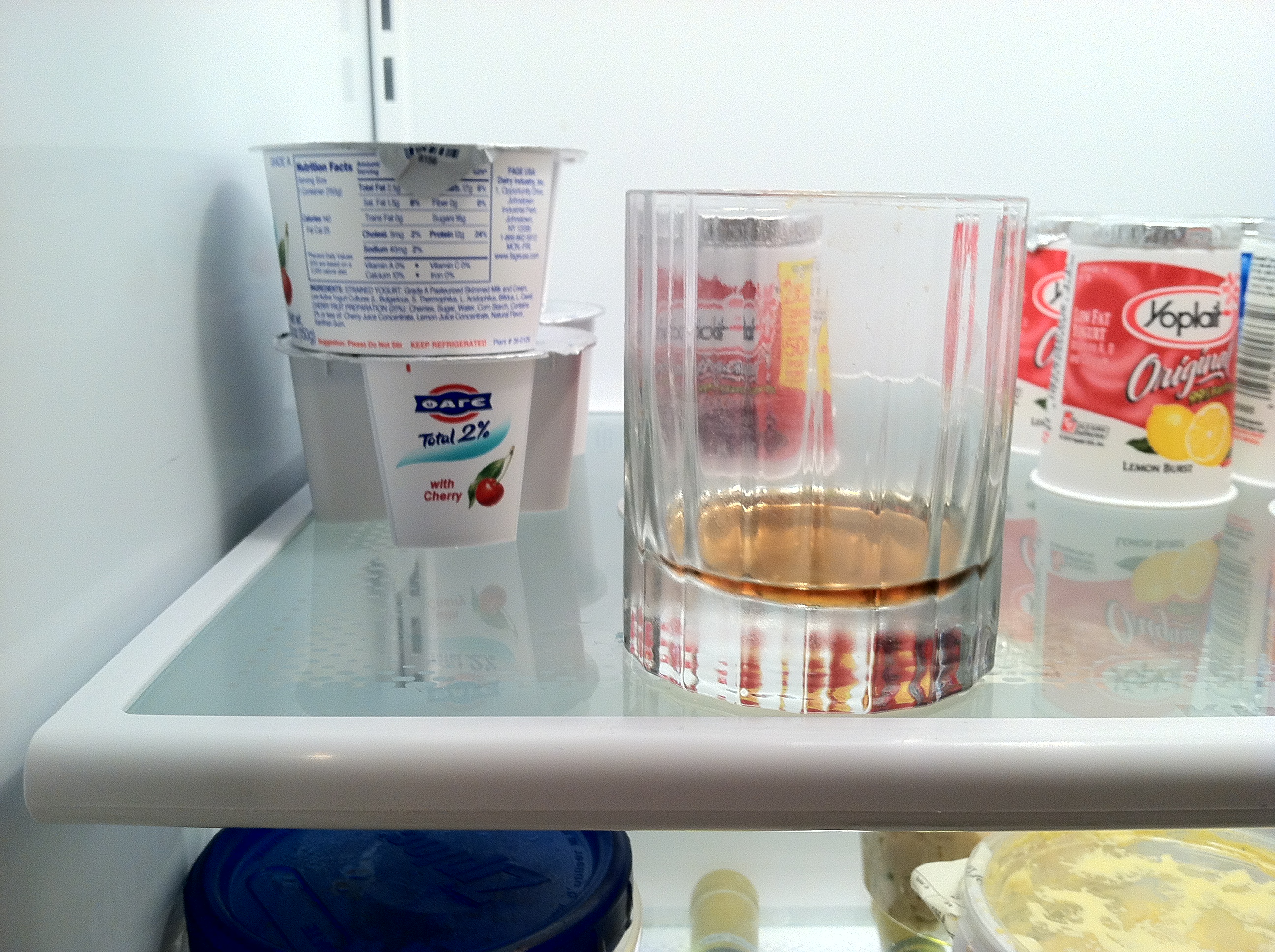
I sent this photo to my daughter-in-law. We'd been talking about how the men leave just enough Coke or juice in a container so that it can spill all over the refrigerator. She wrote back, "Seriously!" We shared a good laugh in minutes.

“And I keep in touch with my nieces and nephews on Facebook. We don’t live in the same cities and they have such busy lives I wouldn’t normally have been able to do that. But on Facebook I can see what they are doing and make a quick comment,” Robin said. “I think we feel closer to each other that way.”

“And I text with my grandkids all the time. I told my grandsons that when they get a text from me that says: THINKING OF YOU, I really mean, I LOVE YOU. I just don’t want to embarrass them if their friends are reading over their shoulder,” I said.

“So maybe it’s not the electronic devices that are in the wrong—it’s the way people use them,” Julie said. “Like the NRA bumper stick: Guns don’t kill. People do. We just need some rules of how and when to use them.”

Somehow my mind created a picture of an iPhone being blown to smithereens, but I quickly pushed it away.

“What a great idea. We just need Smartphone etiquette guides,” I said.

“Yes! We all jumped in using these great devices without thinking there should be some rules about it,” Robin said.

“It wouldn’t have to be too many rules. Just a few to maintain civility,” Marci said.

By then we’d almost completed our circuit and were ready to go on our separate ways. Again we’d aired a popular topic and had set forth many opinions. Then we’d come up with what was needed.

If only we were in charge of the world, I thought. We could solve anything.

Crystal Clear on Seniors

Shame on you, Billy Crystal! Your tasteless and unnecessary joke at the expense of a segment of the population was uncalled for.

No, I’m not talking about the bit with you dressed as the great Sammy Davis, JR in the Midnight in Paris sequence. That was pretty clever and well done. I’m not even talking about the stupid joke that was cynical and mean about a hugging a black woman after watching The Help. That one made no sense and wasn’t funny. (Take my advice and leave African American zingers to someone like Chris Rock. People are way too touchy these days.)

What I am referring to is the throw away line about Christopher Plummer. In a L.A. Times informal poll, 16.98 % agreed with me that making fun of Captain Von Trapp’s age, saying he might wander off during the show, was Billy’s lamest joke. How stupid and uninformed about senior citizens was that? I loved it when Christopher Plummer bounded up the steps to accept his award and gave an articulate and beautifully delivered acceptance speech, as well.

On the other hand, I thought Max Von Sydow and Christopher Plummer looked old for 82. These guys must have lived hard. They looked older than some of the people I just did a Writers Workshop with in Seattle who were all in their mid to late nineties. I’m guessing the Seattleites didn’t do as much partying as the Hollywood set.

I want to let you in on a little truth: 80 is not old. I have many friends who are in their eighties and look like what Hollywood portrays as sixtyish. My friends have as much vitality as I do, as much joie de vivre. Not that some don’t have a few physical issues, but who doesn’t? It comes with the territory. “Getting old is not for sissies,” as Bette Davis said. Of course, in Hollywood, old is probably considered to be 40. Fifty, just ask Demi Moore, is ancient. Sixty? Forget about it!!

Which brings us back to Billy Crystal, who will be 64 this month. You’re almost a Medicare Citizen, Billy—get over yourself! You are not the youthful sprite that you once were—Harry met Sally almost 25 years ago. And Billy, you don’t look healthy, either. The dyed black hair made you look pallid. And your face was so puffy you looked like you were on cortisone or prostate hormone therapy. I don’t believe as some are saying that your round punim came from Botox and fillers. But something’s up.

To be fair, Billy was not alone in his ageist prejudice. From The New York Times: “The whole night looked like an AARP pep rally, starting with an introduction by Morgan Freeman, who was followed by Billy Crystal.” Wow, if they had made an allusion to Morgan’s race or Billy’s religion, the Political Correctness Police would have been issuing tickets right and left.

I didn’t find much written about the fact that many of the Oscars winners were older. And that they won the old fashioned way: they earned them through superior work. The younger generation has a hard act to follow.

Two Steps Behind

I am in a continual state of being two steps behind in this technological world. I just can’t keep up. Neither can my ancient computer nor my copy machine.

My first confession is that I am a slow texter. I don’t like to make mistakes so I actually read over what I’ve written, which slows down the pace. But the biggest problem is my chubby fingers, which are constantly hitting a key I don’t want. The worst is when I hit send without meaning too. Sometimes I send a message that says, “G#bf3td”. It’s so embarrassing, let alone uncool.

I can’t say I am getting any better. If only the keyboard was different and the keys further apart! Apple, you have a lot to answer for. And can there be some UPDATES in this department? What if there was an attempt to change the set up so that the period and comma were on the alphabet keyboard? And the apostrophe! (I am sure if anyone who is younger than 35 reads this, they will tell me of some changes I don’t know about.)

I won’t give up, though. I think texting is an important way to keep in touch with my kids and grandkids and my niece and nephew. It’s instant, which makes it so personal. More important, it’s the only way I can get some members of my family to communicate with me at all. I love the photos and videos that keep me posted—and make me feel I am almost there. I get these almost in sync with event.

One day I really got into texting myself. I was shopping for boots and wanted my daughter’s advice so I texted her photos of the different selections. That was fun—I didn’t have to write anything.

Golden Oldies?

Old Friends and New


“You can make wonderful new friends, but you can never make an old friend,” my friend, Carol, told me a few years ago. I’m not sure what she was referencing, but its truth still reverberates in my head. Although I have made fantastic new friends since we moved to Palm Springs, there’s a tie that binds you to your old friends that is enduring. A shared history cannot be created anew.

Carol and I have been friends since seventh grade. We both are educators, although within the field we took different paths. We now take a Girl Trip every year with two other friends we’ve known since we were—well—girls. Judy I’ve known since first grade. Joan, since I was ten. These get-a-ways have ranged from staying at a cabin on an island in Washington state to a spa experience in Napa. But it doesn’t matter where we are—at The French Laundry or grilling in the backyard, each trip is an immersion in memories, talks about what we are doing and thinking now, and always, always, laughter that evolves into outright giggles.

When we go on these trips, we share a room. I haven’t shared a room with anyone but a family member for a long, long time. I was a little nervous about it. I like to stay up reading until pretty late, and I’m not a good sleeper. Would I disturb my roommate? What about bathroom issues? Closet space? Plucking a hair on my chin?

It ended up that I shared with Judy. She and I have very similar handwriting for two reasons. One, we were both in Mrs. Dorn’s class and we learned to write from her. (I know this for a fact because I recently looked at my sixth grade picture. On the back, Mrs. Dorn had written something in handwriting that is close to identical to mine.) The second reason is that although I was actually sloppier, I loved the way Judy’s writing looked so I copied her.

But, I digress as usual. Back to sharing a room. Although we share similar script, our lives had moved in very different directions. Judy became an executive in a large company. I taught in a small school, and did diapers. We hadn’t been close for decades. Would this work, I wondered. My fears were put to rest as we put out our products on the bathroom counter. Toothpaste, the same. Shampoo, the same. Vitamins, the same. Etc, the same. It was truly astounding.

I come away from these trips knowing more about me than when I arrived. My old friends have memories of me that I have forgotten. It has become a merging of who I was with who I am, and brought me a sense of wholeness that I didn’t even know was lacking.

Last night, we had two couples over for dinner that we have known for a thousand years. We all got married within a month of each other. As I set the table, I thought of all the times we’d had each other over before—how as young brides, we’d been trying to impress with our limited hostess prowess. As young parents, we’d have the gang of babies lined up in high chairs. Then, in a flash, our kids had grown up and we all have grandkids.

We aren’t as close as we once were—geographically we are spread out. Our lives have diverged, but we know each other so very well. The conversation last night could have been on the same topic—childhood pranks and travails—but it couldn’t have been the same with new friends. That’s because when Gloria told the story of how she had gotten her older brother into trouble, I could picture it exactly. Her brother was my brother’s best friend. When Mike talked about his mother, I could picture her exactly—because I knew her. And that’s how the night unfolded—story after story that we all connected to.

I am leading a writing workshop with Carol this winter at an assisted living facility. One topic we had the seniors write about was what they cherished now that they didn’t before. Ava wrote that it was friendship. Before, she’d had her husband and children, her music and her place in the Seattle Symphony Orchestra. Now, she cherished her closeness to her friends.

So I guess the Girl Scouts have had it right all along: “Make new friends, but keep the old. One is silver and the other gold.”